
Captive Redux: IT Services Buy Scale, Margins Loom
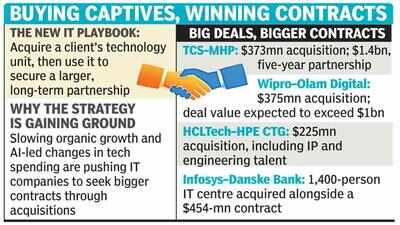
Indian IT majors are increasingly acquiring captives and specialized tech units to anchor larger deals, a strategy driven by slowing organic growth and AI-driven spending shifts. Recent examples include TCS's $373 million acquisition of Porsche's MHP, Wipro's $375 million deal for Olam's digital arm, HCLTech's $225 million purchase of HPE's Communications Technology Group, and Infosys's acquisition of Danske Bank's 1,400-person IT centre. While these deals bring revenue and talent, analysts question whether they are capability plays or mere capacity additions, with concerns about margin dilution from high-cost structures. Key signal: TCS is acquiring Porsche's tech subsidiary MHP for $373 million as part of a $1.4 billion, five-year partnership, with MHP contributing ~$865 million revenue and 4,500 employees. For hiring leaders, this matters because for CHROs and GCC leaders, this trend signals a new wave of consolidation where captives become strategic assets for IT services firms. The acquisitions will reshape talent demand, as thousands of employees transition to new employers, impacting retention, culture, and skill deployment. The margin pressure means firms will likely push for productivity gains through AI and automation, affecting workforce planning and upskilling priorities. GCC leaders should assess whether their centres are seen as core or non-core, as this determines their future under new ownership. Teksands view: This is a classic 'buy vs build' moment for Indian IT. The deals look good on revenue, but the real test is whether they can transform these high-cost captives into efficient, AI-driven units. For talent leaders, the immediate challenge is integration: retaining key people, aligning compensation, and managing culture clash. The long-term play is upskilling these teams for AI-era work, or the margin dilution will eat the deal's value. Watch for how TCS handles MHP's German cost base—it's a litmus test for the whole strategy.
Key fact
TCS is acquiring Porsche's tech subsidiary MHP for $373 million as part of a $1.4 billion, five-year partnership, with MHP contributing ~$865 million revenue and 4,500 employees.
Why it matters
For CHROs and GCC leaders, this trend signals a new wave of consolidation where captives become strategic assets for IT services firms. The acquisitions will reshape talent demand, as thousands of employees transition to new employers, impacting retention, culture, and skill deployment. The margin pressure means firms will likely push for productivity gains through AI and automation, affecting workforce planning and upskilling priorities. GCC leaders should assess whether their centres are seen as core or non-core, as this determines their future under new ownership.
The Teksands point of view
This is a classic 'buy vs build' moment for Indian IT. The deals look good on revenue, but the real test is whether they can transform these high-cost captives into efficient, AI-driven units. For talent leaders, the immediate challenge is integration: retaining key people, aligning compensation, and managing culture clash. The long-term play is upskilling these teams for AI-era work, or the margin dilution will eat the deal's value. Watch for how TCS handles MHP's German cost base—it's a litmus test for the whole strategy.
Got a tech role that's refusing to close?
Send us the JD. We'll tell you whether the problem is talent supply, compensation, location, process - or the JD itself.